4' 33"
Click per la versione italiana
Imagine going to a concert. You take your seat, the pianist walks on stage, sits at the piano… and doesn’t play a single note. Minutes pass, the tension in the room builds, someone coughs, someone else tries to hold back a giggle. After four minutes and thirty-three seconds, the pianist stands up, takes a bow, and walks off stage. That’s it. End of piece.
If you think it’s a joke—surprise! It really happened. The piece is called 4'33", composed by American musician John Cage (1912–1992), and in 1952 it turned the music world upside down—without containing a single note. Brilliant? Ridiculous?
Cage had a very specific idea: silence doesn’t actually exist. During a visit to the anechoic chamber at Harvard University (a room designed to eliminate all sound), he realized he could still hear things: his heartbeat, his breathing, the blood flowing in his body. That’s when it hit him: “silence” is never truly silent. It’s full of sounds we usually ignore. That’s why 4'33" isn’t a silent piece at all, but an invitation to listen to everything around us that normally goes unnoticed: the rustle of jackets, someone breathing nearby, the ticking of a watch, or maybe even that annoyingly well-timed phone ring. In that sense, every performance of 4'33” is totally unique—unrepeatable and full of surprises.
But why exactly 4 minutes and 33 seconds? Cage didn’t pick the duration randomly. 4 minutes and 33 seconds equals 273 seconds, and -273.15 °C is absolute zero, the theoretical and unreachable temperature where matter stops vibrating altogether and true silence could, in theory, exist.
When 4'33" was performed for the first time, the audience was baffled. Some people got angry, some applauded, others felt they’d been scammed out of the price of their ticket. But Cage’s message was clear: music isn’t just what comes out of instruments, it’s everything around us.
Today, 4'33” is a cult classic, performed (or rather, “not performed”) in concert halls around the world. Is it a provocation? Maybe. But it’s also a powerful reflection on what it really means to listen. So next time someone says, “what an awkward silence,” think of John Cage. And maybe enjoy that silence. It might just be the most interesting thing you’ll hear all day.
JW
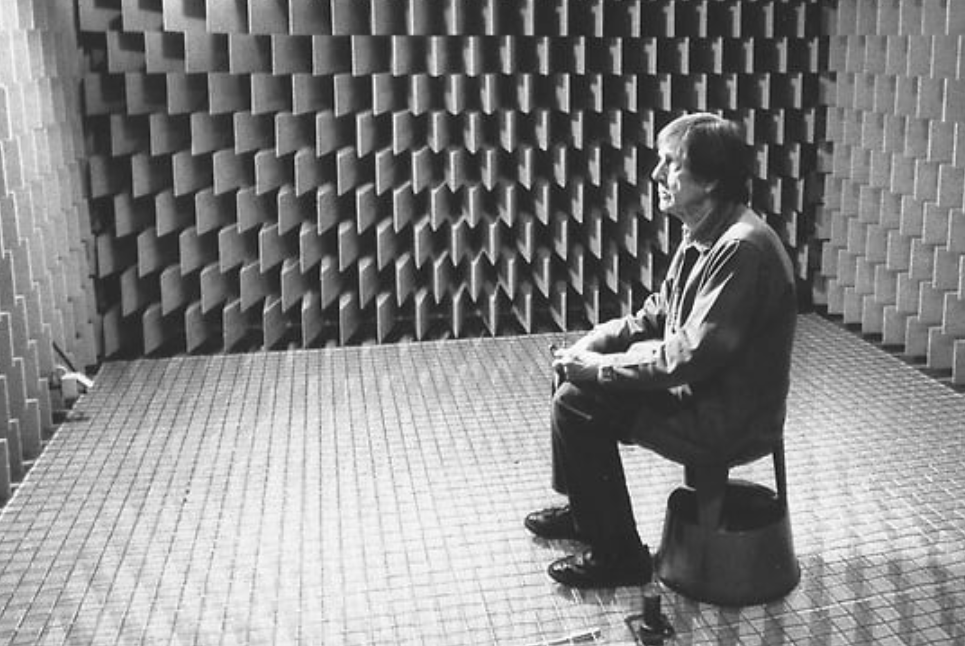 Cage in the anechoic chamber
Italiano
Immagina di andare a un concerto. Prendi posto nella platea, il pianista entra in scena, si siede al pianoforte… e non suona nulla. Passano i minuti, l’imbarazzo cresce, qualcuno tossisce, qualcun altro cerca di trattenere una risata. Dopo quattro minuti e trentatré secondi, il pianista si alza e, fatto l'inchino di rito, se ne va. Fine del pezzo.
Se pensi che sia uno scherzo, sappi che è successo davvero. Si tratta di 4'33", del compositore statunitense John Cage (1912-1992), un brano che nel 1952 ha rivoluzionato la musica senza contenere neanche una nota. Geniale? Assurdo?
Cage era un compositore con un’idea chiara: il silenzio non esiste. Durante una visita alla camera anecoica dell'Università di Harvard (una stanza progettata per eliminare ogni suono), si accorse che percepiva ancora diversi rumori: il battito del suo cuore, il suo respiro, il sangue che circolava. Da lì l’intuizione: il "silenzio" non è mai tale, ma è pieno di suoni che di solito ignoriamo. Ecco perché 4'33" non è un pezzo muto, ma un invito ad ascoltare tutto ciò che esiste e di solito passa inosservato: il fruscio delle giacche, il respiro del vicino, il ticchettio di un orologio, magari anche quel fastidioso squillo di cellulare che arriva sempre nei momenti sbagliati. In questo senso ogni performance del brano sarà unica, irripetibile e sorprendente.
Ma perché proprio 4 minuti e 33 secondi? Cage non ha scelto la durata a caso. 4 minuti e 33 secondi equivalgono a 273 secondi e -273,15 °C è la temperatura dello zero assoluto, il punto teorico e irraggiungibile in cui la materia stessa smette di vibrare e si può verificare l'unica situazione di vero silenzio. Quando 4'33" fu eseguito per la prima volta, il pubblico rimase spiazzato. Alcuni si arrabbiarono, altri applaudirono, altri ancora pensarono di essere stati derubati del prezzo del biglietto. Eppure, il messaggio di Cage era chiaro: la musica non è solo quello che viene prodotto dagli strumenti, ma tutto ciò che ci circonda.
Oggi 4'33" è un’opera di culto, eseguita (o meglio, “non eseguita”) nei teatri di tutto il mondo. È una provocazione? Forse, ma è anche una riflessione profonda su cosa significhi davvero ascoltare. Quindi, la prossima volta che senti qualcuno dire “che silenzio imbarazzante”, pensa a John Cage. E magari goditelo, quel silenzio. Potrebbe essere la cosa più interessante che ascolterai in tutto il giorno.
JW